Showing posts with label USGA. Show all posts

Teeside Improvement

We have started the work around the teeside equipment this week.  Last week we did a test run on #10 to see the reaction from the membership and from our corporate office.  After some positive reviews we have been given the approval to proceed with the project.  We are now in the middle of the #1 project.


This project reduces the labor to just doing a simple edge along the outside rather than having a person weedeat the entire half moon each week.  If you have any comments please feel free to send away.


If you have any questions please feel free to contact me.

Justin Ruiz, CGCS, MG
justinr@indiansummergolf.com

Indian Summer Field Trip

 This Friday we had a visit from Pope John Paul II Highschool.  They had a field trip to the course to learn about plants. It was a great trip I think I was able to open their eyes about golf course management.  They couldn't believe that the green was real grass and they had fun wondering the putting green looking for a place to pull their samples.  Their assignment was to sketch to different kinds of grass plants.

A special thanks to The First Green. They were able to connect the school with us. Also, I would like to thank their teacher Dick O'Conner.

If you have any comments or questions please contact me.
Justin Ruiz, CGCS, MG
justinr@indiansummergolf.com


#15 drainage revisited

 It was roughly a year ago when we tackled a drainage project on the 15th fairway.  The fairway was extremely wet in the landing area.  To resolve the problem we install a herringbone drainage system in the landing area that would move the excess water into the nearby lake.

The fairway turned out very well.  In the past we had to shut the fairway down to all traffic from the 150 yard marker to the green each winter.

This year we were able to keep the fairway open and mowed all winter.  Some days were pretty wet, but the difference was the rate at which the fairway drained.

Here is a video of the water flowing from the fairway into the lake.

If you have any questions or concerns about the golf course please feel free to contact me.

Justin Ruiz, CGCS, MG
justinr@indiansummergolf.com

Bunker Work

This Spring we did some work to the bunkers.

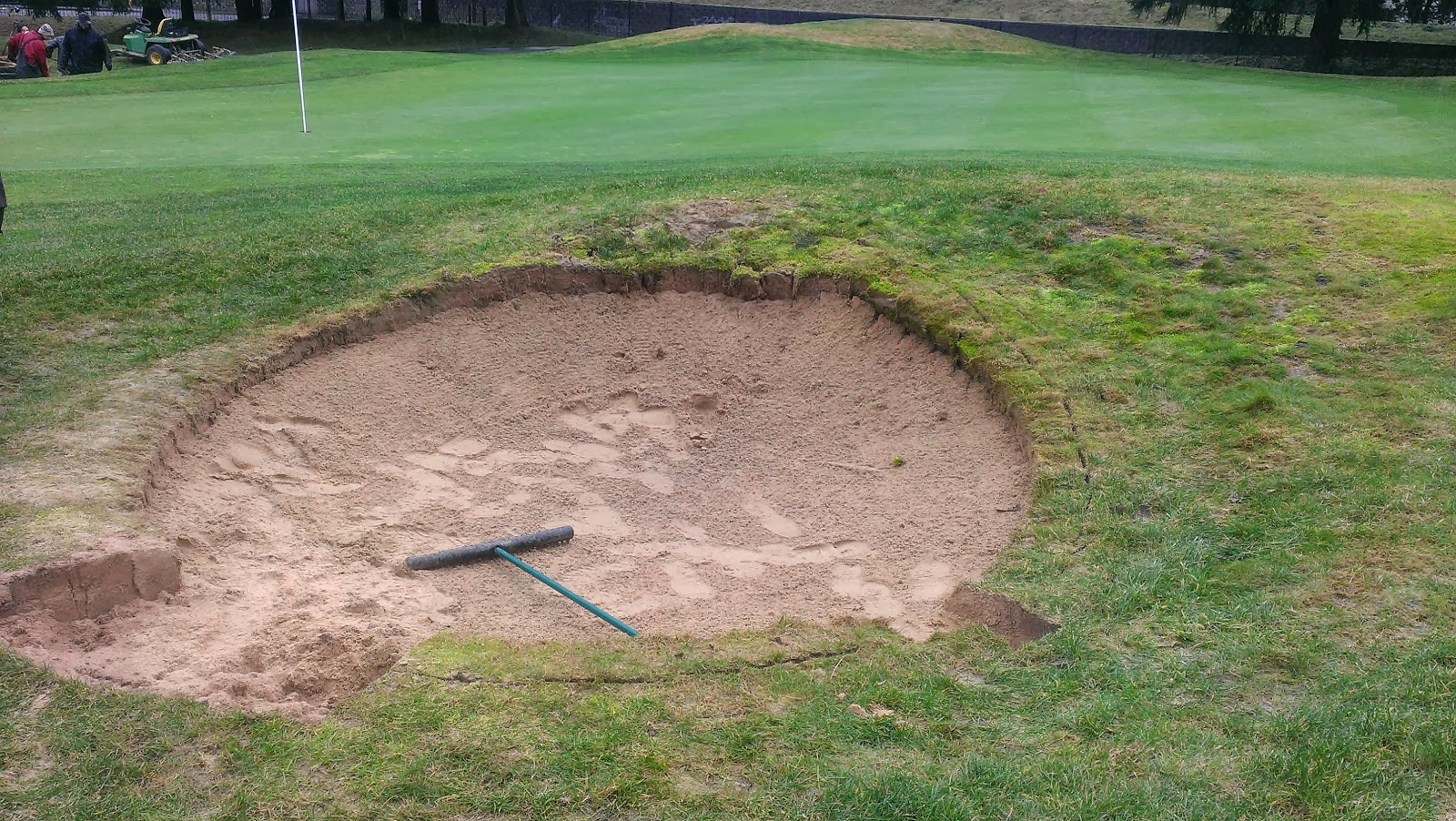
 The edges have become weak and encroached into the bunkers in many areas.  We removed some of the sod back to the original edge of the bunker.  The removal also gives us a more stable base for our surround mower.


Some of the bunkers needed quite a bit of work to bring them back to the original size.

Although the bunker work might go unnoticed on most bunkers, it will add to the play-ability of the golf course.

If you have any questions or concerns on the golf course please feel free to contact me.

Justin Ruiz, CGCS, MG
justinr@indiansummergolf.com

Small Putter Repair

The last aerification cycle we harvested some of the plugs to replace some of our small putting green.  If you have been around the practice area lately you probably have noticed this area.  We currently have it roped off and it will not be usable until spring.

Thanks for your patience.

If you have any questions please feel free to contact me.

Justin Ruiz, CGCS, MG
justinr@indiansummergolf.com
The chipping green project is coming along nicely. We started the project last fall during aerification.  We used the plugs that we harvested from the greens to create a new chipping green.  My vision was to have the green represent the golf course much better and also give our members many more options to practice their short game.

The small chipping green is now roughly double the size.  It has three distinct tiers that flags can be placed on the green.  Many more shots can be played around the green by either running it up the tier or having a shot that might land on one tier and filter down to the next.  I wanted to exercise the imaginations of the golfers. If you want to increase your short game imagination, Steven, Sam and Brandon can show you some very unique shots that will not only impress your friends, but might save you a couple strokes as well.

We are still in the process of coming down to the final height of cut that will match the greens on the course.  The green will provide a true comparison to the golf course.

If you have any questions about the new chipping green or want to add some ideas to the practice center
improvement plan, please feel free to contact me.

Justin Ruiz, CGCS, MG
justinr@indiansummergolf.com

Greenhouse Installation


This winter has been busy for us on the turf team.  We have started and finished many projects and are still trying to tie up more projects before the grass begins to grow too fast.
Another project that we have been working on this winter was the installation of a greenhouse in our maintenance area.  The greenhouse will give us the ability to grow our own annual plants for color in the summer months.
We spend a few thousand dollars every year to purchase annual color for the clubhouse and around the course.  Our greenhouse project has cost a fraction of the price and I expect that we can cut our costs in half if not more by growing our annual plants from seed.

I will post more pictures as we begin to assemble the new greenhouse and start planting our new annuals.  I am hoping to grow some perennial plants as well to either replace, add to or create new landscaped areas that will help add some finishing touches to the golf course.  The greenhouse will give us the ability to have more control on when we want to install our annuals and how healthy they are coming into the season.

I have to thank our new mechanic Geoff Adams.  This has been his project and he originally tossed the idea onto the table as a way to become more self sufficient and be able to utilize our composted green waste.  He has been a great addition to the staff and he has done wonders to our shop as well.

If you would like to check out the behind the scenes action at Indian Summer. Please feel free to contact me and I would love to show you our progress.

Justin Ruiz, CGCS, MG
justinr@indiansummergolf.com  

Drainage #15

It has been a busy winter.  We have been trying to get a few projects done this winter to prepare the course for the spring and summer season.  One of the projects that I had been talking about was drainage.  We got one section of drainage done on #15.  It was right in the landing area where golfers were having a lot of trouble during the wet months of the year.


The project took us a little longer than expected because just as we were wrapping up the pipe installation we had a two week cold snap.  This kept the area frozen and hard to work with.  Once the freeze lifted we were able to put the project to bed and start working on other areas of the course.


The picture on the left is the final look after we laid the sod back.  The area has already begin to dry up and the drainage has been working well.

If you have and questions or comments please feel free to contact me.

Justin Ruiz, CGCS, MG
justinr@indiansummergolf.com

Bunker Work

We have been doing some work in the bunkers over the last few weeks.  The sand has sloughed off of the sides over the winter months from regular maintenance and stormy weather.  We are trying to return the bunker shape to the original design with a more bowl shape into the bunker and not such deep bunker lips.
The work we are doing will be part of our training program for the new staff this spring.  It will be their responsibility to maintain this look as they rake the bunkers throughout the season.  I am also going to switch up some of the maintenance to see if we can do more hand raking and less mechanical raking.  It seems like the mechanical rake does more damage than good.

I would like to ask our members a favor during the 2013 golf season.  Please enter and exit the bunkers on the least sloped areas of the bunkers.  This will help maintain our bunker faces and not accelerate the movement of the sand to the bottom of the bunkers.  We will try to place the rakes in the best positions for entry and exit so that members will utilize these areas more often. We are also placing the rakes on the opposite sides of the green when possible so that there will not be a rake between the green and the bunker.

If you have any questions please feel free to contact me.

Justin Ruiz, CGCS, MG
justinr@indiansummergolf.com
   

Club Entrance part 2

We have completed one side of the entrance to the club. Here are some pictures of the work we have been doing to the entrance over te past few weeks.

 
The project is nearly done with minor detail work to give it a more polished look. Thank you for your patients during this project. The entrance was quite a mess for a while.

If you have any questions please feel free to contact me.

Justin Ruiz, CGCS, MG

justinr@indiansummergolf.com

Latest News

Recently I was interviewed by BASFTurf Talk on the challenges that I expect to face this summer and what I do to beat those challenges. If you would like to read the article please click the link.

Guest blogger superintendent Justin Ruiz

If you have any question please contact me,

Justin Ruiz, CGCS, MG

justinr@indiansummergolf.com


Divot Party

The divot repair party was a huge success. The members had a great time on the golf course and helped our staff by filling in all the divots on the fairways and tees.

I have had quite a few members ask me if I prefer that divots are filled with sand or to replace the pelt. It is a great question and I always answer it the same.a I feel that repairing the divot is best done with sand and seed.
 
A divot that has the pelt replaced is prone to failing unless it is a large enough piece of sod to stay in the hole. The fairway mowers will most likely pull the replaced turf out of its hole. The blower will also blow replaced divots out of their hole as well. Sand and seed performs best in both situations.
 
I would also like to address the driving range divots. I have sen a few blog posts from other superintendents showing divot patterns that they have requested at their golf courses for quicker healing. Taking divots in rows or strips will help the grass fill in quicker. Below are a couple of pictures to show you the difference.
 
The top picture show a strip of divots. Then the next strip was started yet leaving some grass between the two strips. This has a much quicker healing time. The bottom picture shows a more traditional pattern. It makes for a long recover time when a large area like this is removed. The grass has a long way to go to get to the middle of that area and seed has less protection from the elements and mowers.
 
If you can please try to take divots in strips this would help with the recovery time and help us utilize our range more efficiently.
 
If you have any questions about the divot party or the range divot patterns please contact me.
 
Justinr@indiansummergolf.com


Tree Backup

One very important tree had a considerable loss. The maple tree in the fairway on number twelve lost a large branch. The branch left a huge wound in the side of the tree. Since this tree is integral to the layout of the hole, I brought in a certified arborist to give us an idea on what we could do to save this tree.

I knew that the loss of that tree would change the hole dramatically. I explained the importance to the arborist and he recommended that we plant a backup tree behind the existing tree and when the tree does indeed fail, we will already have a replacement established.

We decided to install a Sequoia. This is the only Sequoia tree on the golf course. This tree should give the hole some unique character. The tree is currently staked and we recommend that you take free relief if you are around the new tree. It will take a little time for it to adapt to its new environment.

If you have any questions please contact me.

Justin Ruiz, CGCS, MG

justinr@indiansummergolf.com


150 Marker Test

The 150 markers on the course used to be green posts. The posts became maintenance nightmares. The poles needed to be removable for playability purposes but, they became crooked and started to lean due to the repeated rrwmovaland replacement. They also were cumbersome for the rough mowers to hop of and remove while they were mowing. We have removed the posts and are looking at some replacement ornamental grasses.

The ornamental grasses will be inside a circle that we can easily maintain and the circle will be large enough for the rough units to maneuver around. The ornamental grasses will look better overall and be less labor intensive.
We are going to place the grasses near the putting green for the members to review. If you have a certain grass that you like please bring it to the golf committee, Trish or myself. We will bring the comments to the golf committee meeting for review.
If you have any questions please feel free to contact me.
Justin Ruiz, CGCS, MG
justinr@indiansummergolf.com

Bunker Work

We still have our winter crew which makes us carefully pick and choose which projects we start this spring. Working I between storms and clean up has been a chore. We are behind schedule on many projects that I would have liked to see get done this winter. A smaller staff, no mechanic and the clean up of the recent ice storm has made us push projects back repeatedly.

With the season beginning and aerification only weeks away, we have been just trying to get the course ready for our membership. Spring cleaning is the main focus as we come into season. The bunkers are one of those maintenance items that must be taken care of every year.
In previous years we have added sand to the bunkers as the sand has sloughed off of the sides. Between the rain and the trap rake the sand has all collected at the bottom of the bunkers. Over the season this has created a large lip that is rather unsightly.
This year we did not order any more sand to add to the sides because there is plenty of sand in the bottom of the bunkers. Although time consuming, we have started pushing the sand back up onto the sides after we edge the bunkers. Our goal is to keep a two inch lip around the bunker.
What does that mean to our members you ask?
The sand along these edges are going to be relatively soft until the rains can help pack the sand. We do some packing with the rakes and sand pro but, the sand will remain soft enough to plug your ball into. After a few weeks the bunkers will begin to firm up and return to releasing the ball to the bottom of the bunker. Hopefully you will bear with us as we make efforts to increase playability and presentation of the golf course this season.
If you have any questions please feel free to contact me.
Justin Ruiz, CGCS, MG
justinr@indiansummergolf.com

Spring is In The Air

The week ended well with a good dose of vitamin D. The grass is starting to grow a little quicker on the golf course. We are trying to get the golf course ready for the Masters Tournament that will be played in a couple weeks.
The greens are doing well but we are going to be patient with and height of cut changes until the weather warms up a little more. (Although the greens were surprisingly fast, last Thursday.) We are still experiencing frost any morning it is not raining. If we get to impatient it could hurt us coming into aerification.
Here are a few recent pictures of the course.

If you have any question please feel free to contact me,
Justin Ruiz, CGCS, MG
Justinr@indiansummergolf.com

Spring Sting

Believe it or not the first day of spring was today. I know it was hard to tell with the snow mixed with rain. Although yesterday it was sunny while the snow fell. So that has to be the sign that spring is here. Well another good barometer for judging the arrival of spring is the germination of annual plants. Stinging Nettle is one that we have a lot of during the season along the border of the golf course.

Stinging Nettle seems to be everywhere. The plant is apparent in fertile soils that have been recently disturbed. Makes pretty good sense. When the golf course was built there was some good amount of disturbance along the border of the golf course along along the wooded areas. It seems to be like a wall of Nettles in some places. Since we have done a lot of storm clean up along the border of the course, the additional disturbance I felt would produce a generous crop of the nettles.

This spring we are trying to act while the plant is young and control the weed with a selective herbicide to give us some relief. If the plant rubs against your skin most people feel a stinging sensation that becomes very itchy later. This is not an ideal situation for a golfer that would like to look for a shot that rolls just off the border of the turf. We are trying to act early to catch the plant young and also avoid the time at which new leaves begin to start on the shadowing trees.

If you have any questions about our weed control strategy or if you have any comments about the course please feel free to contact me.

Justin Ruiz, CGCS, MG

Justinr@indiansummergolf.com


Aerification Day

We finished the front nine today.  The greens became a little soft from the amount of material we were removing and being a little soft from the recent rain.

Overall the process went well with one minor set back.  The aerifier blew the clutch causing a two hour delay while we got the aerifier from Hawk's Prairie.  Rick was nice enough to let us borrow his machine to finish today and complete the back nine tomorrow.
The greens will be a little bumpy over the next few weeks.  Please bear with us while we are building the foundation for the future health of our playing surfaces.
If you have any questions or comments please feel free to contact me.
Justin Ruiz, CGCS
Justinr@indiansummergolf.com


Fall Aerification 2011

This week is aerification week.  Yes, it is that time of year again.  The course will have the nine holes that we are not punching open for play.  On Tuesday the 20th, we will aerify the front nine.  On Wednesday the 21st the back nine will be our focus.  Weather depending we should have all the greens aerified and sanded.

The spring aerification consisted of a slightly different process then what was completed in the past.  We used seven inch long tines, three inches longer than the standard aerification tines.  We were able to get below the thatch layer and increase the ability for deeper roots and healthier turf.  This also resulted in softer conditions during aerification.

The USGA recommends a 20% removal of organic matter each year.  This is a good number for maintenance purposes.  This does not take in account if you already have a little extra thatch.  It is important for us to reduce thatch to increase drainage and avoid turf problems in the future.  If you would like to read in more detail about aerification, click here.

IMAG0015

This fall we will be using another process that is unique to this property.  We will use ½” quad tines to remove a little extra organic matter.  These tines will be the usual four inch depth.  The change in depth is to also avoid any plow pan that may occur from continuous aerification at the same depth.  Plow pan is when the roots reach the depth of the aerification tines, but cannot penetrate any deeper.  If we can keep changing it up hopefully we will eventually get roots down deeper.

If there are any questions about aerification or the science behind the process feel free to contact me.

Justin Ruiz, CGCS
justinr@indiansummergolf.com


Check out YouTube Videos

Total Pageviews

Followers

is where my documents live!

Follow JustinRuizCGCS on Twitter
Look inside >
32 33
COVER STORY
Look inside >
14 15
Hole of the Month
Look inside >
31
waterwise PART THREE